Judy: the ship’s dog who became a prisoner of war
A Royal Navy pointer who survived two sinkings and more than three years in Japanese prison camps, and won the Dickin Medal in 1946.
Warships often adopted animals as mascots. [3] Only one dog is known to have been officially registered as a prisoner of war in the Second World War. Her name was Judy, a liver-and-white English pointer, and her number was 81A. [1, 2]
Her story has been retold many times, and some details shift from one telling to the next. Here we follow the records of The National Archives, the PDSA, the Ministry of Defence and the Imperial War Museums, and we point out where they disagree.
A puppy from Shanghai
Judy was born in February 1936 in Shanghai, one of seven puppies, in a kennel used by Europeans living in the city. She was first called Shudi, a name that soon became Judy. Towards the end of 1936 she was bought as the mascot of HMS Gnat, a Royal Navy gunboat based in China, and looked after by the ship’s butcher, who was given the title “Keeper of the Ship’s Dog”. [1]
She was not a natural gundog. The Ministry of Defence says attempts to train her for shooting parties ashore failed, and she kept falling overboard, so the ship had to stop to fish her out. But she earned her place: she warned the crew of river pirates in the dark, and could pick up the sound of approaching Japanese aircraft before the sailors could. [3] In mid-1939 some of the Gnat’s crew moved to HMS Grasshopper, and Judy went with them. [1]
Shipwrecked
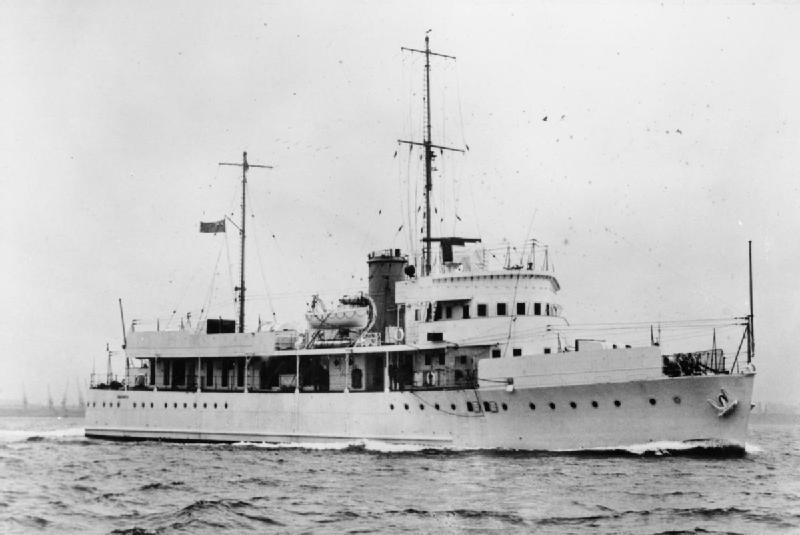
In February 1942, as Japanese forces advanced on Singapore, HMS Grasshopper set off for the Dutch East Indies (now Indonesia). On the way she was bombed by Japanese aircraft and the crew abandoned ship. [1] The plate on Judy’s collar dates the bombing and sinking to 14 February 1942. [5]
The survivors, including men from another British ship, HMS Dragonfly, were stranded on an uninhabited island with no water. Judy went missing, and when the men found her she had dug a hole and found fresh water. [1, 3] Leonard Williams, a sailor on the Grasshopper, later told the Imperial War Museum: “Judy was a saviour then. She was a marvellous life-saver.” [3]
The group was picked up and taken to Singkep Island, then went by boat to Sumatra and on through the jungle, where an alligator left Judy with a two-inch cut over her left eye. They reached the port of Padang too late: the last evacuation ship had gone. [1, 3] The survivors, and Judy, were taken prisoner by Japanese forces. [1]
Prisoner 81A
Within days the prisoners were at Gloegoer camp in Medan, in northern Sumatra, where Judy was at first hidden from the guards. By August 1942 she had met Leading Aircraftman Frank Williams of the RAF, who shared his daily rice ration with her. Years later he remembered thinking: “what on earth is a beautiful English Pointer like this doing here, with no one to care for her”. [1] From then on, the two were inseparable. [2, 3]
Frank persuaded the Japanese to enter her in the camp register. The PDSA’s 1946 announcement says he convinced the commandant that she was an official mascot, and she became prisoner “81A Gloegoer Medan”, with rations of her own. [1] In return she warned the men of wild animals, snakes and other dangers, and distracted the guards when prisoners were being punished. She was beaten with rifle butts herself when she tried to defend them. [1, 2, 3]
Torpedoed
In June 1944 the prisoners were moved by ship to Singapore. Dogs were not allowed on board, so Judy was smuggled on in a rice sack and lay still for three hours without being found. [1] Leonard Williams remembered that the men had trained her to hop into the sack at a signal. [3]
On 26 June 1944 the ship was torpedoed by a British submarine whose crew did not know it was carrying prisoners of war. [3] Frank pushed Judy out through a porthole. [1, 3] In the water she helped men who could not swim, pushing pieces of wood towards them. [1, 2, 3]
Survivors were pulled aboard a Japanese tanker, Judy among them. The guards said she would be killed when they reached land, but the former commander of the Medan camp, who had grown fond of her, stepped in and saved her life. [2, 3] It was about a month before Frank, now in a new camp, knew she had survived. When he walked in, he said, “a scraggy dog hit me square between the shoulders and knocked me over!” [1]
The jungle railway
For the next year Frank, Judy and their fellow prisoners were made to cut a route through the Sumatran jungle for a new railway. Food was scarce and disease was common. [1] Judy survived several camp moves, gunshot wounds, alligator bites and attacks from wild dogs. [2, 3] Japan surrendered in August 1945 and the camps were freed. [1]
Home, and a medal
Judy was smuggled once more, this time aboard the troopship Antenor, where she stayed hidden for most of the six-week voyage to Britain. She then spent six months in quarantine before she and Frank were reunited. [1]
On 30 April 1946 the PDSA announced that Judy would receive the Dickin Medal, often called the animals’ Victoria Cross. [1] She was presented with it in May 1946. [1, 2] Her citation reads: “For magnificent courage and endurance in Japanese prison camps, which helped to maintain morale among her fellow prisoners and also for saving many lives through her intelligence and watchfulness.” [2] Frank was given the PDSA’s White Cross of St Giles for the care he had given her. [1] Her medal is engraved with her name, her ship and “P.O.W. 1942-1945”, and numbered 37. [4]
Later life
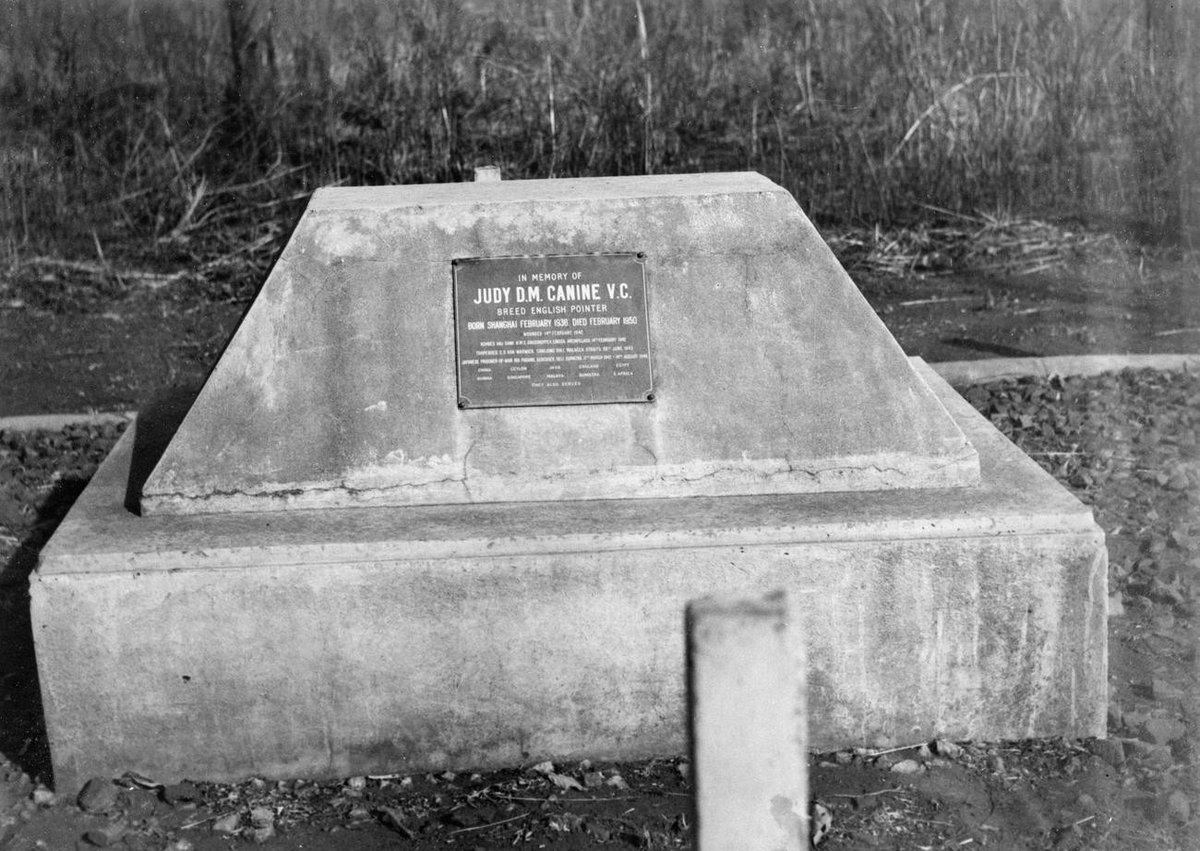
Judy and Frank stayed together after the war, first in Portsmouth and then in Tanzania, where Frank took a British government post in 1948. Judy died there on 17 February 1950. She was buried in an RAF jacket, and Frank built a memorial at her grave with a plaque telling her story. [1, 3] In 2006 the Williams family gave her Dickin Medal to the Imperial War Museum, which also holds her collar. [1, 4, 5]
Where the accounts differ
- When she was registered as a prisoner. The National Archives and the PDSA’s own 1946 announcement say Frank persuaded the Medan commandant while they were in the camp. The Ministry of Defence and today’s PDSA page say the former Medan commander had her listed as a prisoner after the 1944 sinking, to stop her being killed. [1, 2, 3]
- The name of the ship that was torpedoed. The National Archives calls it the Haugiku Maru. The Ministry of Defence and the PDSA call it the SS Van Warwyck. [1, 2, 3]
- How many died. All three sources put about 700 prisoners on board. The National Archives says more than 500 people died; the Ministry of Defence says 500 were killed; the PDSA says only 200 survived. [1, 2, 3]
- Who smuggled her aboard. The National Archives credits Frank. Leonard Williams spoke of what “we” did, suggesting several men helped. [1, 3]
- Dates. The National Archives gives 18 March 1942 for the capture; her collar says 17 March. The collar says she was torpedoed on 26 July 1944, which the Imperial War Museum notes should read 26 June. The Ministry of Defence article gives her death as 1960, but The National Archives, the PDSA and the plaque on her grave all say 1950. [1, 2, 3, 5]
Further reading
Ad: The book title below links to Amazon. If you buy through it, WoofWisdom earns a small commission at no extra cost to you. As an Amazon Associate I earn from qualifying purchases. We chose this book ourselves, and nobody paid to be included.
- Judy: A Dog in a Million Ad · Amazon (opens Amazon in a new tab) by Damien Lewis (Quercus, paperback): a full-length telling of Judy’s life and the men who served and were imprisoned alongside her, for adult readers. Another edition is titled Judy: The Unforgettable Story of the Dog Who Went to War and Became a True Hero.
Sources
These are official archive, museum, charity and government pages. The direct quotations come from the sources shown.
- The National Archives (UK). Judy, the only dog registered as a prisoner of war. https://www.nationalarchives.gov.uk/explore-the-collection/stories/judy-the-only-dog-registered-as-a-prisoner-of-war/ (includes the PDSA’s 1946 announcement and Judy’s citation, Air Ministry file AIR 2/5036)
- PDSA. Judy: PDSA Dickin Medal 37, awarded 1946. https://www.pdsa.org.uk/what-we-do/animal-awards-programme/pdsa-dickin-medal/judy
- Ministry of Defence (24 July 2015). Judy: The Dog who became a prisoner of war. GOV.UK. https://www.gov.uk/government/news/judy-the-dog-who-became-a-prisoner-of-war (quotes HMS Grasshopper sailor Leonard Williams from an Imperial War Museum interview)
- Imperial War Museums. Dickin Medal, boxed (Judy’s medal, catalogue number EPH 9321). https://www.iwm.org.uk/collections/item/object/30089080
- Imperial War Museums. Collar, dog (Judy’s collar, catalogue number EPH 9320). https://www.iwm.org.uk/collections/item/object/30089079
Image credits
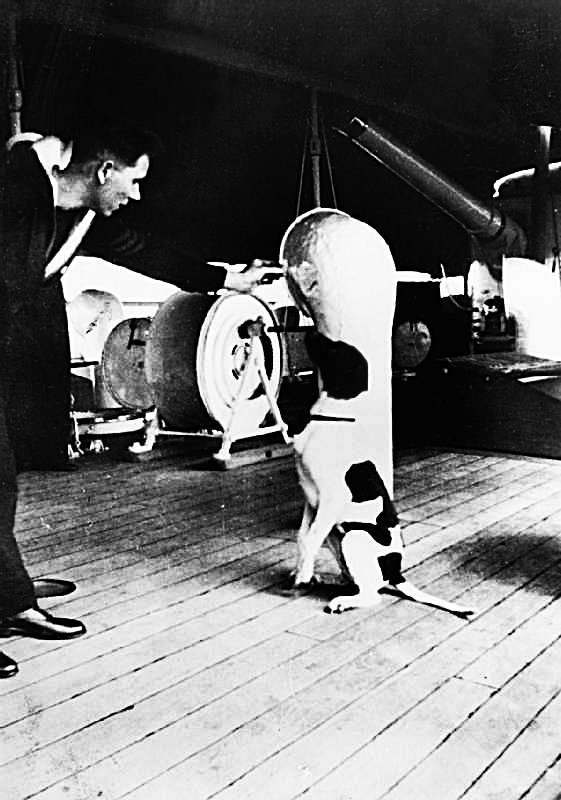
- Judy sits up for a sailor on the deck of HMS Grasshopper. Imperial War Museums photo HU 43990. Public domain (PD-UKGov). Source: https://commons.wikimedia.org/wiki/File:Judy_hu_42990.jpg
- HMS Grasshopper, the river gunboat Judy served on when war with Japan began. Imperial War Museums photo HU 43993. Public domain (PD-UKGov). Source: https://commons.wikimedia.org/wiki/File:HMS_Grasshopper_IWM_HU_043993.jpg
- The memorial Frank Williams built at Judy’s grave in Tanzania. The plaque gives her dates as February 1936 to February 1950. Imperial War Museums photo HU 43991. Public domain (PD-UKGov). Source: https://commons.wikimedia.org/wiki/File:Judy_grave_hu_43991.jpg
Research checked 23 November 2026. These sources inform the article; their authors have not reviewed or endorsed it.
Spotted something? If anything here needs correcting, or you have a question, get in touch through our contact page.